
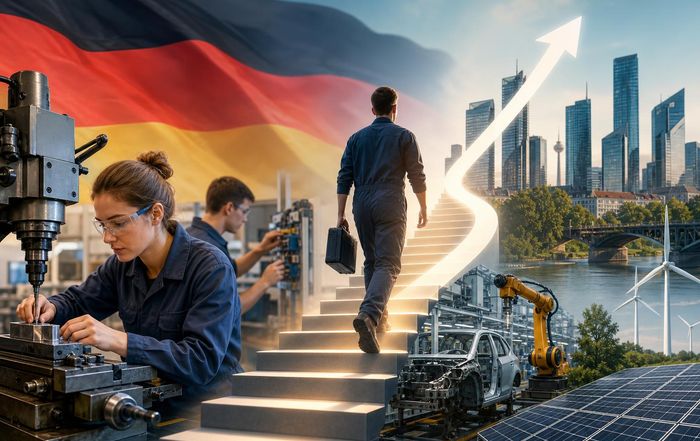
Germany's Industrial Apprenticeships and Career Mobility
Germany's industrial strength is often traced not only to its engineering culture or export prowess, but to a less glamorous institution: the dual vocational training system. The way German industry develops, deploys, and continually upskills its workforce through apprenticeships has become a reference point for policymakers worldwide grappling with skills shortages, stagnant wages, and weak social mobility. Understanding how this system actually works-and how it shapes careers over decades-matters for employers, investors, and workers well beyond Germany's borders.
How Germany's Dual System Works in Practice
Germany's apprenticeship model, commonly called the dual system, combines on-the-job training in a company with classroom instruction in a vocational school. Typically lasting two to three and a half years, apprenticeships are formal employment relationships governed by national frameworks. Apprentices sign contracts, receive regulated training plans, earn a wage, and are covered by social insurance. The system is overseen by a web of institutions including the Federal Institute for Vocational Education and Training (BIBB), industry chambers, trade unions, and regional governments, which together set occupational standards, examination requirements, and certification procedures.
In industrial occupations-such as mechatronics technician, industrial mechanic, process technologist, or electronics technician-apprentices usually spend three to four days per week in a company and one to two days in a Berufsschule (vocational school). The curriculum is tightly aligned with occupational standards negotiated between employer associations and unions, a form of co-determination that helps ensure training reflects real production needs rather than abstract theory. The German Federal Ministry of Education and Research and state-level ministries provide the legal framework and partial funding, while companies shoulder a significant share of the cost by paying wages and dedicating staff to training.
This structure sits at the intersection of education, employment, and business strategy. For young people, apprenticeships are a mainstream alternative to academic higher education, not a fallback. For companies, they are a long-term investment in firm-specific and industry-wide skills. For the economy, they serve as a key mechanism for aligning labour supply with industrial demand, particularly in sectors like automotive, machinery, chemicals, and electrical engineering that underpin Germany's export model.
Why Industry Invests: Economics of Apprenticeship Training
From a narrow accounting perspective, training apprentices costs firms substantial money: wages, trainer time, equipment, reduced productivity in early months, and administrative overhead. Yet research by bodies such as BIBB and the Organisation for Economic Co-operation and Development (OECD) indicates that many German firms recoup much of this investment even during the apprenticeship period, especially in industrial occupations where apprentices quickly contribute to productive work. For larger manufacturers, apprentices often work on standardized tasks under supervision, freeing up qualified workers for more complex activities and reducing overtime costs.
The longer-term payoff lies in lower recruitment expenses, reduced turnover, and better skill matching. Rather than competing in tight labour markets for fully trained workers, firms build their own pipeline, embedding company-specific processes, quality norms, and safety cultures from the outset. This is particularly valuable in Germany's Mittelstand-the network of small and mid-sized industrial firms that dominate niche global markets-where tacit knowledge and close-knit teams are central to competitiveness. Studies by the OECD and European Centre for the Development of Vocational Training (Cedefop) have repeatedly highlighted Germany's relatively low youth unemployment and smoother school-to-work transitions as outcomes linked to this employer investment.
From a macroeconomic perspective, the dual system interacts with Germany's coordinated wage bargaining and export-oriented economy. Sectoral agreements negotiated by unions and employer associations often include clauses on training, minimum apprentice pay, and progression pathways. This institutional architecture helps maintain a broad base of mid-level technical skills that supports advanced manufacturing, while also limiting the emergence of a large low-wage, low-skill service sector. For investors assessing Germany's industrial resilience or for executives comparing global production locations, the apprenticeship infrastructure is as relevant as tax rates or logistics.
Pathways Within Industry: From Apprentice to Specialist
One of the central questions for workers and policymakers is how apprenticeships affect long-term career mobility. In Germany, an industrial apprenticeship is not a dead-end qualification but the first rung of a structured occupational ladder. After completing an apprenticeship and passing standardized exams administered by chambers of industry and commerce or crafts, workers receive a nationally recognized certificate. This credential is portable across regions and employers, which significantly enhances external mobility and reduces the risk that training locks workers into a single firm.
Within companies, former apprentices often move into skilled worker roles with increasing responsibility for quality control, maintenance, process optimization, or supervision. Germany's system of advanced vocational qualifications-such as Meister (master craftsman), Techniker (state-certified technician), and industry-specific specialist certifications-offers further progression without requiring a university degree. These qualifications, regulated under the Vocational Training Act and related legislation, typically combine part-time study with ongoing employment, allowing workers to climb the ladder while remaining in the labour market.
The legal framework has also evolved to strengthen permeability between vocational and academic tracks. In most federal states, holders of certain advanced vocational qualifications gain formal access to universities of applied sciences, and in some cases to research universities. This blurs the once-rigid boundary between "blue-collar" and "white-collar" careers and allows high-performing former apprentices to transition into engineering, business, or technology degrees. Institutions such as the German Rectors' Conference and Standing Conference of the Ministers of Education and Cultural Affairs (KMK) have supported these pathways, which contribute to upward mobility while preserving the practical orientation of initial training.
Lateral Mobility and Occupational Change
Career mobility does not only mean climbing hierarchies; it also involves moving sideways across occupations or sectors as technologies and markets change. Germany's industrial apprenticeship system facilitates this lateral mobility through standardized occupational profiles and transparent skill frameworks. Because curricula and examinations are nationally regulated in cooperation with social partners, employers across the country share a common understanding of what a "mechatronics technician" or "industrial electrician" can do. This reduces information asymmetries in hiring and makes it easier for workers to switch employers or industries without losing recognition of their skills.
At the same time, the specificity of some industrial training can be a double-edged sword. Workers trained in highly specialized processes or legacy technologies may find their skills devalued when entire production lines are automated, offshored, or reconfigured. German labour market institutions attempt to mitigate this risk through publicly supported continuing training. The Federal Employment Agency and programs under the Federal Ministry of Labour and Social Affairs subsidize reskilling for workers in declining occupations, particularly in regions facing structural change, such as former coal and steel areas.
For individuals, the combination of recognized initial training, portable credentials, and subsidized upskilling means that an apprenticeship can serve as a robust platform for multiple career shifts over a lifetime. For example, a machine tool operator might transition into maintenance, then into industrial IT or quality management, leveraging both prior experience and additional certificates. This dynamic is increasingly relevant as digitalization and climate policy reshape industrial value chains, from automotive to chemicals and heavy machinery.
Digitalization, Industry 4.0, and New Skill Demands
Germany's push toward Industry 4.0-the integration of cyber-physical systems, data analytics, and networked production-has profound implications for apprenticeship content and career trajectories. Industrial occupations are being redesigned to include competencies in programmable logic controllers, sensor technology, data interpretation, and human-machine interaction. Bodies such as BIBB and the social partners have updated training regulations for key industrial trades to reflect these changes, while companies integrate new learning modules on digital diagnostics, predictive maintenance, and process visualization.
This transformation is not purely technical. It shifts the balance of tasks within industrial jobs, requiring more problem-solving, cross-functional communication, and continuous learning. Apprentices are increasingly exposed to interdisciplinary projects that combine mechanical, electrical, and IT components, mirroring the convergence seen in modern production environments. For career mobility, this can be an advantage: workers with hybrid skills are better positioned to move into roles at the interface of production and IT, such as industrial data specialists or automation coordinators.
However, the speed of technological change raises concerns about whether the dual system can adapt quickly enough. The process of revising occupational standards-while inclusive and consensus-based-can be slow compared to the pace of innovation in areas like artificial intelligence and industrial IoT. Some critics, including analysts at institutions like ifo Institute and DIW Berlin, argue that Germany risks skill mismatches if curricula lag behind frontier technologies. Others counter that the strength of the system lies in its focus on foundational competencies-mathematics, physics, systems thinking, and troubleshooting-that remain relevant even as specific tools evolve.
For readers following artificial intelligence and automation, the German case offers a nuanced picture: rather than replacing apprenticeships, digitalization is reshaping them, and by extension, the careers they underpin. The key policy challenge is ensuring that trainers themselves are continuously upskilled and that small and medium-sized enterprises, not just large manufacturers, can access advanced training infrastructure.
International Comparisons and Policy Transfer
Germany's industrial apprenticeship model has attracted sustained international attention. Policymakers in the United States, United Kingdom, Canada, and several Asian and African countries have explored adaptations, often with support from organizations such as the International Labour Organization (ILO) and World Bank. Initiatives range from bilateral projects that involve German chambers of commerce helping to establish dual-style programs abroad, to domestic reforms that introduce apprenticeship standards, employer incentives, or work-based learning components into existing systems.
Yet direct transplantation has proven difficult. The German system is embedded in a broader institutional context that includes strong sectoral employer associations, influential trade unions, co-determination in company governance, and a cultural acceptance of vocational routes as high-status options. In countries where vocational education is stigmatized as second-best or where employers are fragmented and reluctant to invest in training that might benefit competitors, replicating the German model is challenging. Reports from the OECD and European Commission repeatedly emphasize that successful reforms require long-term commitment, social partner engagement, and alignment with local labour market structures.
For international businesses evaluating talent pipelines across regions, this context matters. A German industrial apprentice typically enters the labour market with several years of firm-based experience, a standardized qualification, and exposure to workplace norms, whereas in some other countries, entry-level workers may have more classroom hours but less practical training. This affects onboarding costs, productivity ramp-up times, and the feasibility of advanced manufacturing investments. For readers focused on global investment strategies, understanding these institutional differences is as important as analyzing wage levels or tax regimes.
Social Mobility, Inequality, and Inclusion
A core promise of vocational pathways is to enhance social mobility by offering well-paid, skilled careers to those who do not pursue academic degrees. In Germany, industrial apprenticeships have historically played this role, particularly for working-class youth and migrants. The relatively high wage levels in manufacturing, supported by collective bargaining, mean that skilled industrial workers can achieve middle-class living standards without university credentials. This stands in contrast to some liberal market economies where non-graduate routes often lead to low-wage service jobs with limited progression.
However, the picture is not uniformly positive. Research by institutions such as the German Institute for Economic Research (DIW Berlin) and OECD has highlighted persistent inequalities in access to high-quality apprenticeships. Children from families with lower educational backgrounds and those with migrant roots are overrepresented in less prestigious occupations and underrepresented in high-demand industrial and technical trades. Informal recruitment practices, reliance on personal networks, and early educational tracking in the school system can reinforce these disparities.
Gender segregation is another concern. Women remain underrepresented in many industrial apprenticeships, particularly in metalworking, automotive, and electrical trades. Efforts by government agencies, employer associations, and unions to promote gender diversity-through outreach campaigns, mentoring programs, and targeted scholarships-have had gradual but limited impact. As Germany confronts skilled labour shortages in industry, improving inclusion is not only a social justice issue but an economic necessity.
For policymakers concerned with employment and education, the German experience suggests that strong vocational systems can support mobility, but only when combined with broader measures to tackle early disadvantage, discrimination, and occupational segregation. The dual system does not automatically level the playing field; it must be actively managed to avoid reproducing existing inequalities.
Demographic Change, Green Transition, and Future Pressures
Demographic shifts are now placing the dual system under strain. Germany's ageing population and declining youth cohorts mean fewer school-leavers are available to fill apprenticeship slots just as many industrial firms are seeking to expand training to address looming retirements. The Federal Employment Agency has reported increasing numbers of unfilled apprenticeship positions in recent years, particularly in technical and craft occupations. This imbalance risks weakening the system's effectiveness and could prompt firms to lower entry requirements or intensify recruitment of international apprentices.
At the same time, the green transition is reshaping industrial skill needs. Sectors such as automotive, steel, and chemicals are undergoing profound transformation as they adapt to climate policies, electrification, and new materials. Apprenticeship curricula are being updated to include topics like battery technology, hydrogen systems, energy efficiency, and sustainable production processes. The European Union's Green Deal and national climate legislation are accelerating these changes, requiring both new occupational profiles and substantial retraining of existing workers.
For career mobility, this presents both risks and opportunities. Workers whose skills are tied to internal combustion engines or fossil-based processes may face displacement, but those who can upskill into new green technologies could see enhanced prospects. Germany's institutional capacity for coordinated training reform, involving government, employers, and unions, gives it a relative advantage in managing this transition compared to countries with more fragmented systems. Still, the scale of change is significant, and the success of these efforts will depend on sustained investment and flexible learning pathways.
Readers with an interest in sustainable industry and innovation will find Germany's approach a live test case: can a mature industrial economy use its apprenticeship system as a lever for decarbonization while preserving social cohesion and competitiveness?
Lessons for Workers, Employers, and Policymakers
Germany's industrial apprenticeships demonstrate how a well-designed vocational system can support both economic performance and career mobility. For workers, the key lesson is that high-quality initial training, combined with recognized credentials and ongoing upskilling, can provide a stable platform for varied careers-even in the face of technological disruption. For employers, the German case shows that investing directly in training, rather than relying solely on external labour markets, can pay off in productivity, innovation, and retention.
For policymakers in other countries, the takeaway is more nuanced. Elements of the German model-such as employer-led standards, dual learning environments, and national certification-can inform reforms, but they cannot be copied wholesale without considering local institutions, culture, and labour market structures. Organizations like the OECD, ILO, World Bank, and European Commission provide comparative analyses and guidance, yet the political economy of building strong vocational systems remains challenging.
Within Germany, the dual system itself is at a crossroads. To remain a driver of mobility rather than a source of segmentation, it must address demographic pressures, deepen permeability with higher education, embrace digital and green skills, and tackle persistent inequalities in access and outcomes. How effectively it adapts will shape not only the country's banking and business environment and stock exchange valuations, but also the lived realities of millions of workers navigating careers in a rapidly changing industrial landscape.
For readers tracking global labour markets, Germany's experience underscores a wider point: in an era of automation, climate risk, and geopolitical uncertainty, the institutions that govern how people learn to work-and how they keep learning-are becoming as strategically important as capital markets or trade agreements. Industrial apprenticeships, once seen as a technical detail of national education policy, now sit near the centre of debates about competitiveness, inclusion, and resilience.
