
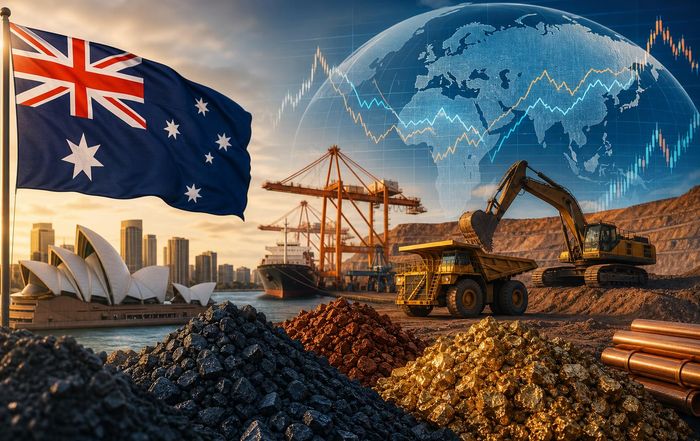
Assessing Australia's Exposure to Commodity Cycles
Australia's modern prosperity has been built in no small part on rocks and soil. Iron ore, coal, gas, gold, and a range of base and critical minerals have underpinned decades of export earnings, budget surpluses, and corporate profits. That success, however, has left the country structurally exposed to global commodity cycles that it does not control. For investors, executives, and policymakers, understanding how deeply these cycles shape Australia's economy is essential to assessing risk and opportunity in everything from equities and currencies to employment and public finances.
This page examines how commodity cycles transmit through Australia's macroeconomy and financial markets, which sectors are most exposed, how the current transition to decarbonisation and new technologies is reshaping the picture, and what diversification strategies are emerging. The focus is on practical implications for trade, investment, and policy rather than a purely historical narrative.
How commodity cycles feed into Australia's economy
Australia is one of the world's most resource-intensive advanced economies. According to Australia's Department of Foreign Affairs and Trade (DFAT), resources and energy commodities routinely account for more than half of total export values, with iron ore, coal, and liquefied natural gas (LNG) dominating the list. Demand from major trading partners such as China, Japan, and South Korea makes the country particularly sensitive to shifts in global industrial production, construction, and energy use. When prices for these commodities rise, export receipts swell, the terms of trade improve, and national income rises, supporting wages, profits, and tax revenues. When prices fall, the process works in reverse, often amplifying global downturns in Australia's domestic data.
This transmission occurs through several channels. First, higher commodity prices directly raise export values, lifting nominal GDP and corporate earnings in the resources sector. Second, stronger profits and investment in mining and energy spill over into related industries such as engineering, transport, and business services, supporting employment and capital expenditure. Third, the Australian dollar (AUD) tends to appreciate in commodity upswings and depreciate when prices fall, as international investors treat it as a "commodity currency." This exchange-rate mechanism partly cushions real activity by making other exports more or less competitive, but it also introduces volatility for import costs and inflation. For readers following global economy trends, Australia is a clear case study in how commodity cycles and exchange rates interact in an open advanced economy.
The boom-bust nature of these cycles can be stark. The early-2000s mining boom, driven by China's rapid industrialisation, lifted Australia's terms of trade to historic highs, sparked a surge in mining investment that reached close to 8-9% of GDP at its peak, and helped the country avoid recession during the global financial crisis. The subsequent downturn in commodity prices from around 2011-2015 saw investment retrench, job losses in mining regions, and pressure on government revenues, even as export volumes remained high. The pattern has repeated in modified form with LNG, and more recently with coal and gas price spikes following Russia's invasion of Ukraine, underscoring how geopolitical shocks can quickly propagate through Australia's commodity-dependent income streams.
Trade concentration and the China factor
Australia's exposure is magnified by the concentration of its export markets. China has been Australia's largest trading partner for years, absorbing a substantial share of iron ore, coal, LNG, and other resources. This concentration means that Australia is exposed not only to global commodity price cycles, but also to the specific policy, property-sector dynamics, and growth trajectory of a single large economy. When Chinese construction activity slows or when authorities adjust steel production or emissions policies, the effects on iron ore demand and prices quickly show up in Australian export earnings and the share prices of major miners.
The link between commodity cycles and geopolitical risk became highly visible during the diplomatic tensions between Australia and China from 2020 onwards. Beijing imposed restrictions or tariffs on a range of Australian exports including coal, barley, and wine. While iron ore remained largely untouched, the episode highlighted how political decisions can overlay and amplify underlying commodity cycles. For investors tracking global and investment themes, this combination of price and policy risk is central to assessing Australia's external vulnerability.
At the same time, Australia has been seeking to diversify its export markets, particularly for LNG and emerging critical minerals. Long-term contracts with buyers in Japan, South Korea, and India, and growing interest from European and Southeast Asian partners, are gradually broadening the customer base. However, given the scale of Chinese demand for iron ore and other bulk commodities, market diversification can only partially mitigate the core exposure in the near term. The broader lesson is that commodity cycles for Australia are increasingly shaped by a mix of macroeconomic forces in China and other Asian economies, climate and environmental policies, and evolving trade relationships.
Fiscal dependence: budgets and commodity windfalls
Australia's federal and state budgets are highly sensitive to resource prices and production volumes. Royalty payments from mining companies, corporate income tax, and personal income tax from well-paid resource-sector jobs all move with commodity cycles. The Australian Treasury has frequently highlighted how unexpected improvements in the terms of trade deliver temporary revenue windfalls, while downturns can quickly erode fiscal positions. The pattern has been visible in recent years, with stronger-than-forecast iron ore and coal prices contributing to better budget outcomes and helping reduce public debt levels.
This dependence creates both opportunities and risks for fiscal policy. On the positive side, commodity booms can provide the revenue space to invest in infrastructure, social services, and long-term productivity improvements, or to build fiscal buffers. On the negative side, governments face the temptation to treat cyclical revenue as permanent, leading to spending commitments that are difficult to sustain when prices fall. Several Australian states with large mining sectors have experienced this tension, as royalty-driven surpluses can rapidly give way to deficits when global demand slows. For readers interested in sovereign risk and banking system exposures, the quality of fiscal management during these cycles is a key determinant of macro-financial stability.
International institutions such as the International Monetary Fund and the World Bank have long advised commodity-exporting countries to adopt conservative budget assumptions for commodity prices and to use windfalls to build stabilization funds or reduce debt. While Australia is often viewed as a relatively strong fiscal performer among advanced economies, debate continues over whether it has fully institutionalised mechanisms to smooth the impact of commodity cycles. The contrast with countries like Norway, which channels oil revenues into a sovereign wealth fund managed by Norges Bank Investment Management, is frequently cited in domestic policy discussions.
Labour markets and regional disparities
Commodity cycles do not affect Australia evenly. Mining and energy projects are concentrated in resource-rich states such as Western Australia and Queensland, and in specific regions within those states. During booms, these areas experience strong job creation, wage growth, and population inflows, sometimes straining housing, infrastructure, and local services. During downturns, the same regions can see sharp rises in unemployment, business closures, and falling property prices, even when national indicators remain relatively stable.
The mining investment boom of the 2000s and early 2010s exemplified this pattern. Fly-in fly-out (FIFO) workforces, high wages for skilled trades and engineers, and rapid construction of LNG and iron ore projects reshaped local labour markets. When prices softened and investment slowed, many of these jobs disappeared or transitioned from construction to lower-employment operational phases. This cyclical hiring pattern complicates long-term workforce planning and has implications for employment policy, training, and regional development strategies.
Australia's relatively flexible labour market and strong service sectors have helped absorb some of these shocks. The Reserve Bank of Australia (RBA) has also noted that exchange-rate depreciation during commodity downturns can support tourism, education exports, and other tradable services, partly offsetting job losses in mining. However, the concentration of high-paying resource jobs means that inequality between regions can widen during downswings. Policymakers and industry are increasingly focused on how to support economic diversification in mining-dependent communities, especially as the energy transition raises questions about the long-term outlook for coal and certain gas projects.
Financial markets: equities, currency, and banking exposure
For investors navigating stock exchange and currency markets, Australia's commodity exposure is both a risk and a trading opportunity. The benchmark S&P/ASX 200 index has a heavy weighting toward large resource companies, including global miners such as BHP, Rio Tinto, and Fortescue Metals Group, as well as energy producers. When global commodity prices rise, these firms often lead the index higher; when prices fall, they can drag the market down even if non-resource sectors are performing reasonably well. This concentration means that international investors often treat Australian equities as a way to gain exposure to global resource cycles, particularly iron ore and coal.
The Australian dollar's status as a commodity-linked currency is also well established. Studies by the Bank for International Settlements and the RBA have documented a strong relationship between Australia's terms of trade and the AUD over the medium term. Traders in foreign exchange markets often use the currency as a proxy for global risk appetite and Chinese growth expectations. This can create overshooting and volatility, as sentiment-driven moves may exceed what fundamentals alone would suggest. For businesses with foreign currency exposures and for households with imported consumption, these swings can affect costs, inflation, and investment decisions.
Australia's banking system, supervised by the Australian Prudential Regulation Authority (APRA), has indirect exposure to commodity cycles through lending to resource firms, service providers, and households in mining regions. While the major banks have diversified loan books and robust capital positions by international standards, past episodes have shown that sharp downturns in resource-intensive regions can lead to higher arrears and losses, particularly in small business and commercial property portfolios. For risk managers and executive decision-makers, understanding regional and sectoral credit concentrations is a key element of assessing the system's resilience to commodity shocks.
The energy transition: new risks and new commodities
The global shift toward decarbonisation is reshaping Australia's commodity exposure in complex ways. On one hand, international commitments under the Paris Agreement, policy changes in major markets, and technological advances in renewables are undermining the long-term demand outlook for thermal coal and, potentially, for some fossil fuels more broadly. This poses transition risks for Australian producers, workers, and regions that rely heavily on coal exports and coal-fired power generation. Organisations such as the International Energy Agency (IEA) have published scenarios in which unabated coal use declines sharply over coming decades, which would have material implications for Australia's export mix.
On the other hand, the energy transition is creating new demand for minerals essential to batteries, electric vehicles, and renewable energy infrastructure. Australia has significant reserves of lithium, nickel, cobalt, rare earth elements, and other critical minerals. In recent years, it has emerged as a leading global supplier of lithium ore, with major projects in Western Australia and growing interest from international automakers and battery manufacturers. Government strategies, including Australia's Critical Minerals Strategy, aim to position the country as a reliable supplier of these materials to partners in North America, Europe, and Asia, with an emphasis on responsible environmental and social standards.
This shift does not eliminate exposure to commodity cycles; it changes their composition. Critical minerals markets can be even more volatile than bulk commodities, given their smaller size, rapid technological change, and concentrated supply chains. Prices for lithium and other battery metals have already experienced sharp booms and corrections in response to changing expectations about electric vehicle adoption, recycling, and alternative chemistries. For investors focused on technology and innovation, this presents both upside potential and heightened risk, as project economics can swing rapidly with market sentiment and policy signals.
ESG, sustainability, and the licence to operate
Environmental, social, and governance (ESG) considerations are increasingly central to Australia's commodity sectors and their global market access. Large institutional investors, multilateral lenders, and corporate customers are demanding higher standards on emissions, biodiversity, water use, Indigenous rights, and community impacts. Failures in these areas can quickly translate into reputational damage, regulatory penalties, project delays, or loss of financing. High-profile incidents in recent years, such as the destruction of culturally significant Indigenous sites, have sharpened scrutiny of mining practices and governance.
International frameworks such as the Task Force on Climate-related Financial Disclosures (TCFD) and emerging sustainability reporting standards from bodies like the International Sustainability Standards Board (ISSB) are pushing Australian resource companies to provide more detailed information on climate risks, transition plans, and scenario analysis. At the same time, global initiatives on responsible mining and supply chains, including efforts by the OECD and sector-specific alliances, are shaping expectations for how critical minerals are produced and traced. For companies seeking to position Australia as a trusted supplier of low-carbon and ethically sourced resources, meeting these benchmarks is increasingly a commercial imperative, not just a compliance exercise.
From a macro perspective, stronger ESG standards can influence the pace and composition of investment in the resource sector. Projects with high emissions intensity or social controversy may find it harder to secure capital, while those aligned with clean energy and circular-economy objectives may attract green finance. This differentiation can, over time, alter the sensitivity of Australia's export earnings to particular commodity cycles, tilting exposure away from declining fossil fuel demand and toward growth segments in renewables and electrification. However, the transition is unlikely to be smooth, and stranded-asset risks remain a concern for coal and potentially some gas infrastructure.
Diversification efforts: services, manufacturing, and value-added processing
Australian policymakers and business leaders have long debated how to reduce the economy's reliance on raw commodity exports. The country has competitive strengths in education, tourism, financial services, healthcare, and advanced manufacturing, as well as in emerging fields such as artificial intelligence and digital technologies. Over time, the share of services in GDP and employment has grown substantially, and exports of education and tourism have become major foreign-exchange earners. The challenge is that, despite this diversification, resources still dominate the trade account and drive large swings in national income.
One strategic response is to move up the value chain within the resource sector itself. Rather than exporting largely unprocessed ores and concentrates, Australia is exploring opportunities in downstream processing, refining, and manufacturing. For example, there is growing interest in lithium hydroxide processing, battery component production, and green hydrogen projects that leverage renewable energy resources. Government initiatives, including various industry funds and tax incentives, aim to attract private capital into these higher-value segments, with an eye to building more resilient industrial ecosystems and skilled jobs.
Another focus is on strengthening innovation and productivity in non-resource sectors so that they can better offset commodity downturns. Investments in research and development, digital infrastructure, and skills development are central to this agenda. Readers interested in education and jobs policy will recognise the importance of aligning training systems with emerging industries, including clean energy, advanced manufacturing, and data-driven services. Success in these areas would not eliminate Australia's exposure to commodity cycles, but it could reduce the amplitude of booms and busts in overall economic performance.
Implications for investors and corporate strategy
For investors, Australia's commodity exposure offers both a source of diversification and a distinct set of risks. Global portfolios can use Australian equities, bonds, and the AUD to express views on commodity prices, Chinese growth, and the energy transition. However, concentration risk needs to be managed carefully, particularly for domestic investors whose employment, housing, and pension savings may already be tied to the national cycle. Diversifying across sectors, geographies, and asset classes can help mitigate the impact of commodity downturns on household and institutional balance sheets.
Corporate strategists and executives operating in or with Australia must also factor commodity cycles into capital allocation, supply-chain planning, and risk management. Scenario analysis that considers different paths for Chinese demand, decarbonisation policies, and technological change in energy and materials can inform decisions about project timing, financing structures, and hedging strategies. Firms with exposure to mining regions may need contingency plans for labour availability, infrastructure bottlenecks, and regulatory shifts during booms, as well as for demand softness and community impacts during busts. For those in business services, logistics, and engineering, understanding the pipeline of resource projects is critical to managing capacity and investment.
At the macro-financial level, central banks, regulators, and fiscal authorities increasingly integrate commodity-linked scenarios into stress testing and policy frameworks. The RBA, APRA, and Treasury monitor how commodity price shocks could affect growth, inflation, financial stability, and public finances. Internationally, bodies such as the Bank for International Settlements and the OECD provide comparative perspectives on how commodity exporters manage these challenges. For Australia, maintaining credibility in macroeconomic management and financial regulation is a key counterweight to the volatility inherent in its export base.
A structural feature, not a temporary condition
Australia's exposure to commodity cycles is not an anomaly that will disappear in a few years; it is a structural feature of an economy endowed with abundant natural resources and deeply integrated into global trade. The composition of that exposure is changing as the world moves away from carbon-intensive fuels and toward metals and materials for clean technologies, but the underlying sensitivity to global price cycles, investment waves, and geopolitical shifts remains. The task for policymakers, investors, and businesses is not to wish away this reality, but to manage it intelligently.
This involves building fiscal buffers, strengthening institutions, and investing in human capital and innovation so that the non-resource economy can thrive alongside a competitive resource sector. It also requires careful navigation of international relationships, particularly in Asia, and proactive engagement with global standards on sustainability and responsible sourcing. For those engaged in global trade, finance, and strategy, Australia will likely continue to serve as both a barometer of commodity-driven cycles and a test case for how advanced economies adapt to a resource-rich but rapidly decarbonising world.
